Lighting technology has evolved rapidly over the last decade, shifting from inefficient incandescent filaments to advanced LED solutions. While low-voltage systems dominate the automotive interior market, the 110v light bulb remains the standard for industrial workshops, residential garages, and specific heavy-duty automotive maintenance scenarios. Whether you are outfitting a professional showroom for high-end vehicles or upgrading your personal garage to work on your car, understanding the nuances of 110V lighting is essential.
This comprehensive guide explores the engineering, applications, and selection criteria for 110V lighting, drawing on the engineering pedigree of GTR to explain how premium lighting transforms visibility.
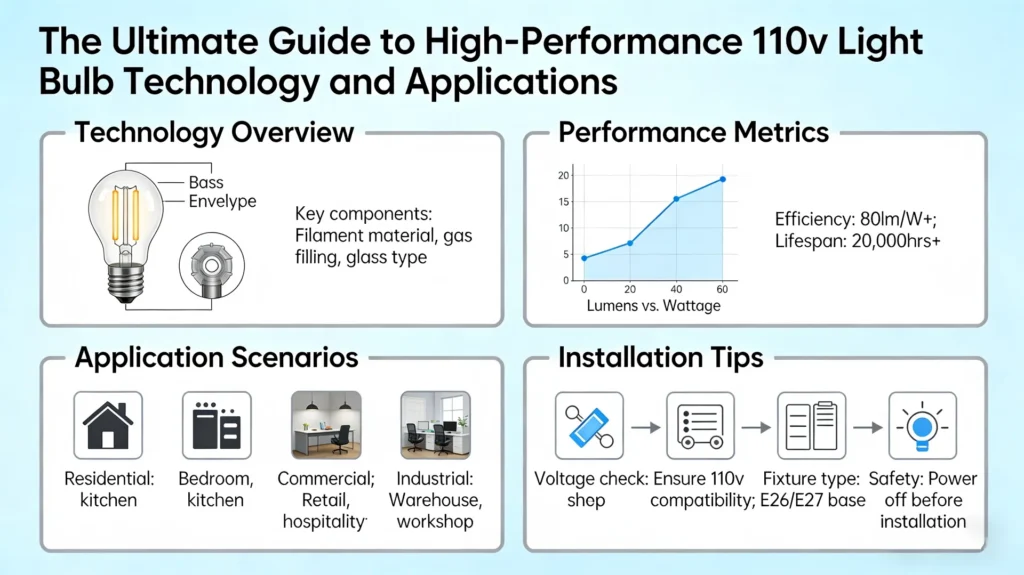
Module 1: Defining the 110v Light Bulb and How It Works
En el fondo, un 110v light bulb is designed to operate on the standard mains voltage found in North America and parts of South America and Japan. Unlike 12V automotive bulbs that require a transformer or a battery source, these bulbs plug directly into the grid current.
The Shift to LED Technology
Modern 110V bulbs predominantly use Light Emitting Diodes (LEDs). An LED driver creates a circuit that converts the high-voltage AC (Alternating Current) from your wall into a lower-voltage DC (Direct Current) that the LED chips can use. This internal driver is the heart of the bulb. High-quality bulbs, like those engineered with principles similar to GTR’s automotive lights, utilize advanced drivers that prevent flickering—a common complaint in Reddit community discussions regarding cheaper alternatives.
Key Components:
- The Socket: Common types include the 110v light bulb e27 (standard screw base) and GU10 (twist-lock).
- The Heat Sink: Essential for longevity. Even though LEDs run cooler than halogens, the internal electronics are sensitive to heat.
- The Lens: Determines the beam angle and light spread.
Module 2: Core Application Scenarios
While standard vehicles like a Toyota Camry or a Tesla Model 3 utilize 12V DC systems for their headlights, the 110v light bulb plays a critical role in the ecosystem surrounding these vehicles.
1. Automotive Workshops and Garages
When detailing a BMW or performing engine maintenance on a Ford, ambient lighting is crucial. High-CRI (Color Rendering Index) 110V bulbs are used in overhead fixtures to reveal true paint colors and swirl marks that standard lighting might miss. Mechanics rely on 110v light bulbs screwfix style heavy-duty work lights to illuminate undercarriages where standard battery lights might fade.
2. RVs and Marine Applications (Shore Power)
Large recreational vehicles often have dual-voltage systems. When an RV is plugged into “shore power” at a campsite, the interior outlets switch to 110V. Here, owners often replace stock bulbs with high-efficiency 110v light bulbs to reduce heat buildup inside the cabin.
3. Industrial Manufacturing
In the factories where vehicles are assembled, high-bay lighting utilizes powerful 110V-277V LED corn bulbs to maintain massive lumen output for safety and precision.
Module 3: Critical Factors for Selection
Choosing the right bulb goes beyond just checking if it fits the 110v light bulb socket. You must evaluate the light quality and durability.
| Factor | Description | Why it Matters |
|---|---|---|
| Producción de lúmenes | The measure of total visible light emitted. | Higher lumens mean brighter workspaces. A garage needs 4000+ lumens per fixture. |
| Temperatura de color | Measured in Kelvin (e.g., 3000K, 6000K). | 6000K (Daylight) is preferred for working on cars; 3000K is for relaxing areas. |
| Heat Dissipation | The ability of the bulb to cool itself. | Poor cooling kills LEDs. Look for aluminum bodies, a hallmark of GTR design. |
| Safety Certification | UL or ETL listing. | Ensures the bulb won’t catch fire under load. |
Module 4: Installation and Maintenance Guidelines
Installing a 110v light bulb may seem straightforward, but safety is paramount when dealing with mains voltage.
Installation Steps
- Power Down: Always turn off the circuit breaker, not just the switch, especially in older buildings.
- Check the Base: Ensure you are not forcing an E27 bulb into an E26 socket (though often compatible, slight differences exist) or confusing it with smaller E12 bases.
- Verify Voltage: Never install a 110v light bulb in 220v fixtures. This will cause the bulb to explode or burn out instantly. This is a frequent error noted in home improvement forums.
Maintenance
LEDs are low maintenance, but dust accumulation on the heat sink can reduce their lifespan. Wipe the bulbs down with a dry cloth every six months to ensure optimal cooling efficiency.
Module 5: Frequently Asked Questions (FAQ)
Q: Can I use a 110v light bulb in a 220v socket?
A: No. Plugging a 110v light bulb in 220v creates an over-voltage situation that will destroy the bulb immediately and poses a fire risk.
Q: What is the difference between E26 and E27 bases?
A: E26 is the standard American base, while E27 is the European standard. They are usually interchangeable for 110v light bulbs, but E27 threads are slightly wider.
Q: Why do my 110V LED bulbs flicker?
A: Flickering often indicates an incompatibility with a dimmer switch or a low-quality LED driver inside the bulb. High-end brands use stable drivers to prevent this.
Q: Are these bulbs suitable for outdoor use?
A: Only if rated for damp or wet locations. Check the packaging for “Weather Resistant” markings.
Q: How long should a good 110V LED last?
A: A quality unit should last between 15,000 to 50,000 hours, depending on thermal management.
Module 6: Why Choose GTR for Lighting Solutions?
While GTR is renowned globally for premium automotive lighting, the philosophy behind our engineering—maximum brightness, superior heat dissipation, and rigorous testing—applies to all lighting physics. When you understand the quality gap between a generic bulb and a precision-engineered product, the choice becomes clear.
GTR focuses on:
- Advanced Chipsets: Using top-tier LED chips that maintain brightness without fading over time.
- Thermal Management: Incorporating aviation-grade aluminum and active cooling fans where necessary.
- Durability: Products tested to withstand vibration and voltage fluctuations.
Upgrading your lighting is an investment in visibility and safety. Whether for your car or your workspace, choosing professional-grade lighting makes all the difference.