Imagine cruising down the fairway or navigating a large industrial complex in your electric utility vehicle. Suddenly, your headlights dim, flicker, and die. For many owners of electric golf carts and forklifts, this is a common frustration rooted in a single, failing component: the voltage reducer. There is a simpler, more robust solution that fleet managers and enthusiasts are discussing on forums from Reddit to specialty EV groups: direct 48v led lights.
This article dives deep into the specific application of high-voltage DC lighting for electric vehicles. We will explore why upgrading to a direct 48-volt system could be the smartest maintenance decision you make, enhancing safety and reliability for vehicles ranging from EZ-GO golf carts to heavy-duty forklifts.
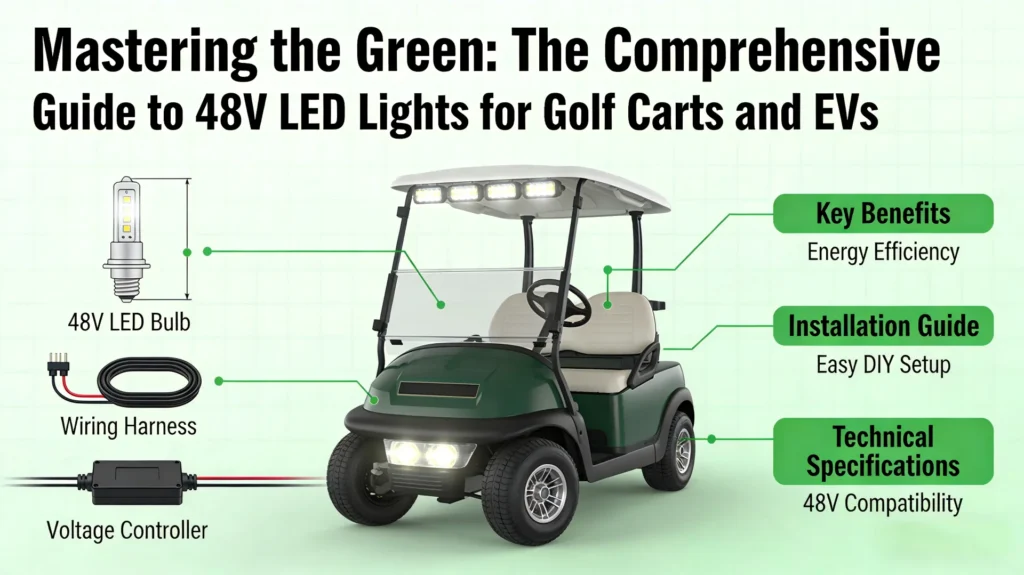
Understanding the Shift: What Are Direct 48V LED Lights?
To understand the value of 48v led lights, we must first look at the power source. Most modern electric golf carts (like Club Car, Yamaha, and EZ-GO) and warehouse forklifts operate on a 48V battery bank. However, traditional automotive LED lights run on 12V.
Historically, this required a “step-down” converter or voltage reducer. This extra piece of hardware takes the 48V from the batteries and converts it to 12V. While functional, it adds complexity, heat, and a point of failure. Direct 48v dc led lights are engineered with advanced internal drivers that can accept the full 48V input directly from the battery pack without needing external converters.
The Core Advantage
By eliminating the reducer, you remove a parasitic load. Users often report that direct wiring results in fewer electrical “gremlins” and a cleaner installation. This technology utilizes robust DC-DC driver chips inside the light housing itself, managing the current to the LED emitters efficiently.
Core Application Scenarios: Where Performance Matters
While 48v led lights are versatile, they shine brightest in specific vehicular applications. Let’s look at where GTR’s specialized lighting solutions are most frequently deployed.
1. Golf Carts and LSVs (Low-Speed Vehicles)
Whether it is a neighborhood cruiser or a course fleet, lighting is critical for safety. Standard 12V lights often suffer from voltage drop if the wiring harness is old. A 48v led lights for golf cart kit connects directly to the battery series. This ensures that even if the battery voltage fluctuates slightly during acceleration, the light output remains steady.
- Common Models: EZ-GO TXT/RXV, Club Car Precedent, Yamaha Drive.
- Usage: Headlights, tail lights, and underbody accent lighting.
2. Industrial Forklifts and Material Handling
Warehouses operate 24/7. Forklifts running on 48V electric systems require safety lights (blue spots, red zones) and work lights. Using 12V lights with converters in a high-vibration forklift environment often leads to failure. Direct 48V working lights are built to withstand the voltage spikes typical in industrial hydraulics.
3. Marine and Off-Grid Systems
While less common than 12V, 48V marine banks are gaining traction for electric propulsion. Using 48v led puck lights in the cabin or engine room reduces copper wire weight significantly, as higher voltage requires thinner wire for the same power.
Key Buying Factors: How to Choose the Right 48V Light
Not all LEDs are created equal. When selecting lighting for a 48V system, you must look beyond the physical shape. Here are the critical factors.
1. Input Voltage Range (The “Swings”)
A “48V” battery does not stay at 48V. When fully charged, it may read near 50-52V. When under load, it drops. A high-quality 48v led lights fixture should have a wide input range, typically 9V-60V DC or 12V-80V DC. This “headroom” prevents the LEDs from burning out during charging cycles.
2. Thermal Management and Heat Sinks
Running LEDs at higher voltages can generate internal heat within the driver components. Look for housings made of die-cast aluminum with prominent cooling fins. Plastic housings often trap heat, leading to premature diode failure.
3. Ingress Protection (IP Rating)
For golf carts and forklifts, exposure to rain, mud, and wash-downs is inevitable.
| IP Rating | Protection Level | Recommended Use |
|---|---|---|
| IP65 | Dust tight, low-pressure water jets. | Interior cab lights, 48v led puck lights. |
| IP67 | Dust tight, immersion up to 1m. | Exterior headlights, light bars. |
| IP68 | Continuous immersion. | Underbody lights, marine applications. |
4. Beam Pattern and Lenses
This is where lens technology comes into play. A standard reflector sends light everywhere. A projector lens (a specialty of GTR) focuses the beam. For a golf cart driving at night, you need a “cut-off” line to avoid blinding oncoming neighbors, while still illuminating the cart path clearly.
Installation: Bypassing the Reducer
One of the most attractive aspects of 48v led lights for golf cart applications is the simplified wiring. Here is a conceptual overview of the process.
Note: Always disconnect the main battery pack before working on electrical systems.
- Step 1: Identify Power Source. Locate your main positive (+) and main negative (-) terminals on the entire battery series.
- Step 2: Remove Old Hardware. If you are replacing a 12V system, disconnect the voltage reducer. You may be able to reuse the existing wiring if it is in good condition, but ensure the switch is rated for 48V.
- Step 3: Direct Connection. Connect the 48v dc led lights harness directly to the main terminals (fused connection recommended).
- Step 4: Verification. Use a multimeter to ensure the voltage at the light connector matches the pack voltage.
This direct architecture minimizes resistance points, which could lead to brighter, more consistent light output compared to a reducer-fed system.
Why GTR is Your Strategic Partner for 48V Solutions
At GTR, we understand that 48V lighting requires more than just changing a resistor. It requires a fundamental redesign of the driver topology.
Engineering Precision: GTR employs advanced thermal simulation to ensure our drivers can handle the wide voltage swings of industrial battery packs without overheating. Whether you need 48v led strip lights for interior ambience or high-power exterior projectors, our testing ensures longevity.
Customization (OEM/ODM): Unlike generic resellers, GTR controls the manufacturing process. We can customize the voltage cutoff, beam angle, and mounting brackets to fit specific golf cart cowls or forklift cages.
Preguntas más frecuentes (FAQ)
Q1: Can I hook these 48V lights up to a 12V car battery?
It depends on the specific product’s range. Many GTR lights are “multivolt” (e.g., 10-60V), meaning they will work on 12V, 24V, and 48V systems equally well. Always check the spec sheet.
Q2: Will 48V lights drain my golf cart batteries faster?
Generally, no. In fact, they may be more efficient. By removing the voltage reducer (which wastes energy as heat), the total system efficiency often improves, potentially extending your range slightly.
Q3: Do I need a special switch for 48V lights?
Yes. Standard automotive switches are rated for 12V DC. Using them at 48V can cause arcing inside the switch contacts, leading to failure. Ensure your toggle or rocker switch is rated for 48V DC or use a relay.
Q4: Are 48V LED strip lights available for under-glow?
Yes, 48v led strip lights are excellent for under-glow because they suffer less voltage drop than 12V strips, ensuring the back of the cart is just as bright as the front.
Q5: What happens if my battery voltage spikes to 55V?
Calidad 48v dc led lights from GTR are designed with over-voltage protection to handle spikes up to 60V or even 80V, common in fresh-off-the-charger lead-acid battery packs.