The search for superior vehicle lighting often begins with frustration. The stock halogen lights are dim and yellow, making night driving a strain. The natural impulse is to search online for the brightest possible replacement. This search inevitably leads to a confusing array of products, many boasting impossibly high specifications. The discerning buyer, perhaps someone who appreciates the precision of a high-quality flashlight germany tool, knows that raw numbers rarely tell the whole story.
When upgrading automotive lighting, you are generally faced with two distinct technological paths: standard LED replacement bulbs that rely on your car’s existing reflector, or advanced LED Lens/Projector systems that bring their own optics. This guide compares these two approaches head-to-head to help you decide where to invest your money for the safest and most effective result.
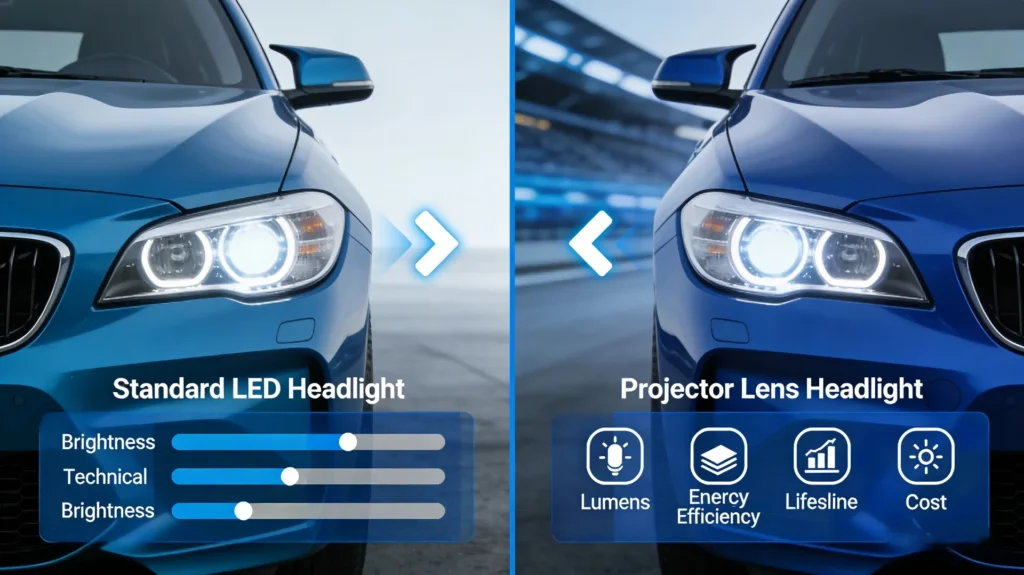
The Core Conflict: Reflector Reliance vs Optical Independence
The fundamental difference between these two technologies is how they manage light. This difference is the deciding factor in performance.
Standard LED “Drop-In” Bulbs (Reflector Based)
These products consist of a stem with LED chips placed roughly where a halogen filament would be. They rely 100% on the chrome plastic reflector bowl already inside your car’s headlight assembly.
- The Problem: Automotive reflectors are optically complex mirrors designed for a tiny, glowing wire filament that emits light in 360 degrees. An LED is a flat square that emits light in about 160 degrees. It is geometrically impossible for a flat LED chip to perfectly match the focal point of a halogen reflector.
- The Result: The light hits the reflector at wrong angles. Instead of being focused down the road, a significant percentage of the light is scattered upwards (glare) or lost sideways. You get a very bright foreground, but poor distance visibility.
GTR-Style LED Projector Lens (Optically Independent)
These units are radically different. They do not care what kind of headlight housing you put them in. They contain their own miniature, precision-engineered optical system.
- The Solution: The LED chip sits inside its own tiny reflector cup, behind a physical metal shield, which is behind a highly polished convex glass lens. The unit shapes the beam *before* it ever leaves the bulb.
- The Result: A “tactical,” highly focused beam of light with vastly superior distance throw and virtually zero wasted light. It is the automotive equivalent of moving from a lantern to a precision spotlight.
Head-to-Head Comparison Table: The Metrics That Matter
Don’t be swayed by marketing claims of “50,000 Lumens.” Here is how the technologies compare in real-world driving metrics.
| Merkmal | Standard LED (Reflector Dependent) | LED Projector Lens (GTR Type) | Winner |
|---|---|---|---|
| Beam Control & Cutoff | Poor to Moderate. Often fuzzy, indistinct edges leads to glare. | Excellent. Sharp, razor-edge cutoff line. Tactical precision. | Projector Lens |
| Distance Throw (Lux) | Moderate. Light scatters before reaching far distances. | Superior. Focused beam maintains intensity far downroad. | Projector Lens |
| Glare for Others | High Risk. Minor misalignment causes blinding glare. | Near Zero. Physical shield prevents upward light bleed. | Projector Lens |
| Foreground Lighting | Very High. Often too bright close to the car, causing distance blindness. | Balanced. Even distribution from bumper to horizon. | Projector Lens |
| Optical Efficiency | Low. Much light is wasted via scatter. | High. Nearly all generated light is projected forward. | Projector Lens |
Deep Dive into Key Buying Considerations
The “Glare” Factor: Why Engineering Matters
The most frequent complaint about aftermarket LEDs on social platforms and forums is glare. If you have ever been blinded by a lifted truck or an older Honda Civic with blinding blue headlights, you have experienced cheap reflector LEDs.
If you value safety and not being a nuisance on the road, a projector lens is the only viable option. The physics of the internal cutoff shield makes it nearly impossible to blind oncoming traffic if the lights are aimed correctly. You get the intense brightness of modern LEDs without the anti-social side effects. This is akin to the difference between a cheap, flooding torch and a precision fenix flashlight germany style beam designed for exact illumination without spill.
The Myth of “Brighter is Better”
Many buyers assume that if a bulb looks incredibly bright when shining on the garage door five feet away, it must be good. This is false. Standard LEDs create intense “foreground light.” While it looks impressive initially, this bright pool of light right in front of your bumper causes your pupils to constrict to limit light intake. This constriction harms your ability to see into the darker, distant zones where hazards at highway speeds actually reside.
Projector lenses are designed to balance this. They push the highest intensity of light (the “hotspot”) right up against the cutoff line, projecting it further down the road, rather than dumping it right in front of the car. This design philosophy aligns with the precision found in high-end European automotive engineering.
Installation Reality Check
Historically, the main argument against projectors was the installation difficulty. It used to require heating the headlight assembly in an oven to separate the glue, physically cutting the reflector bowl, mounting a large projector unit, and resealing the light. It was a weekend-long project with a high risk of damaging the housing.
This barrier has largely been removed by the new generation of “Mini-Projectors” like those offered by GTR. These units have miniaturized the lens technology so effectively that the entire assembly is often no larger than a standard halogen bulb. They can usually be inserted directly through the rear bulb access hole, meaning you get the optical benefits of a custom projector retrofit with the ease of a standard bulb change.
Why GTR Lens Technology is the Tactical Choice
When making a buying decision, it is clear that standard LED drops-ins are a compromise—a modern light source stuck in outdated optics. GTR’s approach to high-performance lighting focuses on bringing the lens solution to the masses.
By choosing a GTR lens product, you are investing in optical control. You are moving away from the “spray and pray” method of lighting the road towards a disciplined, engineered approach. For drivers who demand the best visibility, treating their vehicle’s lighting with the same seriousness one would treat a professional-grade tool, the projector lens is the only logical upgrade.