When you are navigating the intricacies of off-grid living, whether in a high-tech recreational vehicle or a marine vessel, every watt of power counts. The humble 12v 6w led bulb has emerged as a unsung hero in this ecosystem. Unlike standard residential lighting, low-voltage systems require a delicate balance of efficiency and durability. If you have ever browsed Reddit forums dedicated to “vandwelling” or boating, you may have noticed a recurring theme: the frustration with stock lighting that drains batteries or generates excessive heat.
This article dives deep into the specific application of these bulbs, particularly focusing on the 12v 6w refrigerator bulb led and general interior cabin lighting. We will explore why upgrading to premium LEDs, like those engineered by GTR, could be the most significant upgrade you make for your mobile energy management.
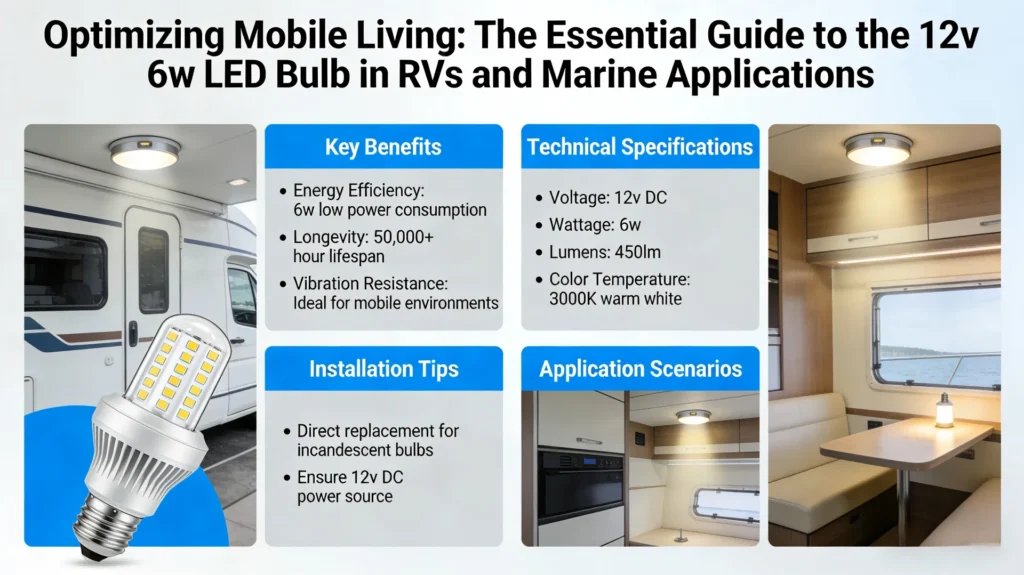
Module 1: Defining the 12v 6w LED Bulb Technology
At its core, a 12v 6w led bulb is a solid-state lighting device designed to operate on a Direct Current (DC) 12-volt system. While it consumes only 6 watts of energy, its light output is often comparable to a 40-watt to 60-watt incandescent filament bulb. This efficiency is achieved through the use of high-quality diodes that convert electricity into visible light with minimal thermal waste.
In the context of a 12v led system, “6 watts” is actually considered a high-output specification for a small form factor. Lower quality bulbs often claim this wattage but fail to deliver the expected lumens due to inefficient drivers. A true 6-watt LED requires a robust internal driver to manage the voltage fluctuations common in automotive and marine alternators, ensuring the light remains steady without flickering—a common complaint found in consumer reviews.
Module 2: The Core Application – RV Refrigeration and Cabin Interiors
While these bulbs are used in various automotive settings, their most critical application lies in the “house” systems of RVs and the specific niche of absorption refrigerators.
The Refrigerator Dilemma
In many older RVs and boats, the refrigerator light is a standard incandescent bulb. This presents a unique physics problem. An incandescent bulb emits 90% of its energy as heat. When you open your fridge, that bulb instantly begins to heat up the very space the appliance is trying to keep cool. By swapping this out for a 12v 6w refrigerator bulb led, you effectively remove a heat source. This might seem minor, but in a solar-powered setup where energy efficiency is paramount, reducing the thermal load on the compressor can save significant battery amp-hours over a long trip.
The “Boondocking” Scenario
For enthusiasts who enjoy “boondocking” (camping without hookups), lighting is the primary drain on house batteries after the water pump and furnace. Replacing ten halogen overhead puck lights with a 12v led light solution can drop the total amperage draw from roughly 20 amps to under 2 amps. This massive reduction allows travelers to extend their off-grid stay by days. Users on Facebook RV groups frequently discuss how this simple swap eliminated their need to run a noisy generator just to charge batteries in the evening.
Module 3: Critical Selection Factors for Mobile Applications
When choosing a 12v led lamp for these specific environments, you must look beyond the price tag. The following factors are non-negotiable for safety and performance.
- Voltage Range (10V-30V capability): A vehicle’s electrical system is rarely a perfect 12 volts. When an alternator is charging, it can spike to 14.5 volts. When a battery is low, it dips to 11 volts. A cheap 12v led bulb designed only for a static power supply will flicker or burn out under these conditions. You need a bulb with a wide operating voltage range.
- Wärmemanagement: In an enclosed fixture or a refrigerator housing, heat dissipation is difficult. High-quality bulbs utilize aluminum or ceramic heat sinks to draw heat away from the sensitive diode.
- Color Rendering Index (CRI): In a small living space, light quality affects mood and visibility. A low CRI bulb makes food look unappetizing and wood interiors look washed out. Aim for a CRI above 80.
- Moisture Resistance: For marine or refrigerator applications, the bulb may be exposed to condensation. Ensure the 12v led housing is sealed or rated for damp locations.
Module 4: Installation and Maintenance Protocols
Installation einer 12v 6w led bulb is generally plug-and-play, but there are nuances in a DC environment.
Polarity Awareness
Unlike AC home bulbs, some older or cheaper DC LEDs are polarity sensitive. This means they will only work if the positive and negative contacts are aligned correctly. If you plug a bulb in and it doesn’t light up, take it out, rotate it 180 degrees, and reinsert it. However, premium bulbs from brands like GTR typically feature “non-polarity” drivers, meaning they work regardless of orientation.
Socket Maintenance
In older RVs and boats, corrosion in the socket is common. Before installing a new 12v led light, use a small amount of electrical contact cleaner or a piece of emery cloth to clean the contact points. This ensures maximum current flow and prevents the bulb from overheating due to electrical resistance.
Module 5: Frequently Asked Questions (FAQ)
1. Can I use a standard 12v 6w led bulb in my RV refrigerator?
It depends on the size. While the voltage matches, refrigerator bulbs often require a smaller form factor (like an E12 or E14 base, or a specific festoon shape). Always verify the physical dimensions of your specific 12v 6w refrigerator bulb led slot before purchasing.
2. Why do my new LEDs flicker when the water pump runs?
This is caused by voltage drop in the RV’s wiring. When a high-draw appliance like a pump turns on, the voltage dips. High-quality LEDs have built-in capacitors to bridge these micro-gaps in power, whereas cheaper units will flicker.
3. Is a 6W LED too bright for a reading light?
It can be. A 6W LED is roughly equivalent to a 40W halogen. For reading, this might be intense. You may want to look for dimmable versions or use this wattage for general overhead area lighting instead.
4. Will these bulbs interfere with my TV or Radio signals?
Cheaply made LEDs often emit Electromagnetic Interference (EMI) which causes static on radios. Premium bulbs use shielded drivers to prevent this “noise.”
5. Do I need to replace the fixture to use these bulbs?
In 95% of cases, no. These are designed as “retrofits” to fit into existing halogen or incandescent sockets.
Module 6: Why GTR is the Logical Choice
When you are miles from civilization, reliability is not a luxury; it is a necessity. GTR understands that a 12v led bulb is a critical component of your vehicle’s infrastructure. Our approach to manufacturing involves rigorous testing against vibration (corrugated roads), thermal shock (freezing to hot), and voltage spikes.
We do not simply source generic components; we engineer lighting solutions. For the discerning owner of a luxury RV, a yacht, or a high-performance vehicle, GTR offers the assurance that your lighting will perform as expected, year after year. By choosing GTR, you are selecting technology that respects the limitations of your battery bank while maximizing the comfort of your living space.
Upgrading your lighting is the single most effective step you can take toward energy independence on the road. Examine your current setup, identify the inefficiencies, and make the switch to a precision-engineered LED solution today.